Hemileuca maia
(Drury, 1773)
Buck Moth
Sort #: 1716 | P #: 890041.1 | MPG #: 7730 | PFG Page #: 252
View on BugGuide | View on iNaturalist | BOLD Link
Larval feeding type: Feeds communally when young, they then disperse and feed singly
Larval substrate: Quercus ilicifolia* (Scrub Oak), occasionally also Quercus rubra* (Northern Red Oak) where this grows together with Scrub Oak
Phenology: Adult: 6/23 to 10/29 (140 records)
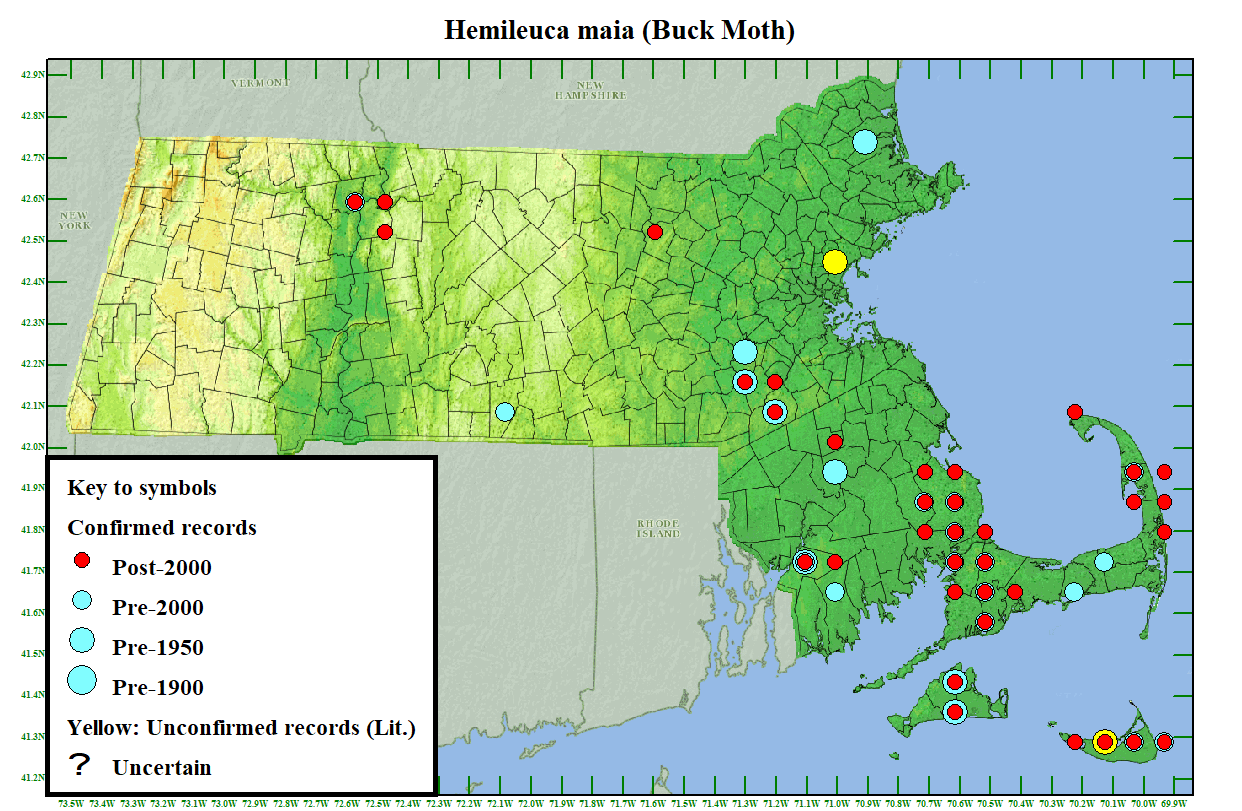
Comment: Frequents dry barren habitats with a lot of scrub oak. There may be some hybridization with H. lucina where populations are close. The standard DNA BIN sequence cannot distinguish between the two species. Hemileuca maia was split into several subspecies by Pavulaan, 2020 (Taxonomic Report of the International Lepidoptera Survey, 8(5): 1-16) and these subspecies were raised to species in the latest North American checklist (St Laurent in Pohl & Nanz, 2023). Accordingly, Hemileuca maia is restricted to coastal areas of New York and Massachusetts. Inland populations (also coastal from New Jersey southwards) are referable to Hemileuca sandra. Pavulaan, 2020 provided a map for the distribution of his different subspecies wherein he refers the population in western Massachusetts to what would now be called Hemileuca sandra. However, he provides no evidence for this interpretation. Until a more thorough analysis of the populations in Massachusetts has been undertaken, we are keeping everything under Hemileuca maia.
Status in MA (automated assessment): Fairly widespread, common
Status in N. America: Native
MA Endangered Species Act status: Special Concern
First Year Reported: 1833
Last Year Reported: 2026
Distribution by County: Franklin, Worcester, Essex, Norfolk, Bristol, Plymouth, Barnstable, Dukes, Nantucket
Number of Records: 445